Perfect tubes at record speed
How surface defects can be avoided using QASS measurement technology while simultaneously increasing the productivity of the tube drawing line.
Used by:
We're in good society.




Avoid chatter marks
Chatter marks are reliably avoided with our Optimizer4D measuring system in conjunction with our special structure-borne sound sensors. Prevent damage to your products and improve quality.
100 % Inline monitoring
We use our high-performance measuring devices to monitor every single millimeter of the pipe drawing process, at any drawing speed. Manual intervention by the employee is unnecessary.
Maximum drawing speed
By reliably preventing chatter marks, drawing speeds can be increased by 10 to 20% without compromising the quality of the drawn tubes.
Retrofit made easy
Our technology can be integrated into any pipe pulling system, regardless of age, manufacturer or condition. We provide customized solutions for machine communication.
Automated prevention of chatter marks with QASS
The first solution for preventing chatter marks while simultaneously increasing drawing speed
During tube drawing, even smallest changes in temperature, material, lubricant, or tool condition can lead to production defects and instabilities. These can set the system into vibration, ultimately causing surface defects (chatter marks) on the inside or outside of the tube. The vibrations begin imperceptibly until the chatter becomes audibly noticeable as a distinct humming sound. The machine operator must detect this acoustically and reduce the drawing speed as quickly as possible to prevent further damage to the newly produced tubes. However, by this point the defect has already occured, and some of the new tubes are already marked with chatter marks.
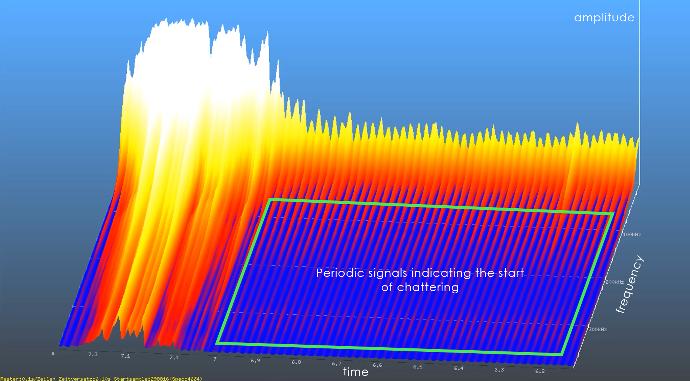
Our highly sensitive structure-borne sound sensors can detect even the smallest vibrations in real time. This allows us not only to reliably identify the chatter itself, but also to detect the slightest precursor signals that occur just a few milliseconds before the actual chatter. As soon as these precursor signals are detected by our sensors, our measurement system can automatically reduce the drawing speed for a few seconds, allowing the process to stabilize again. In this way, chatter marks are completely avoided, as the system is stabilized before reaching the critical chatter phase - at a point when no surface damage has yet occured. After stabilization, the drawing speed is increased again to its previous level.
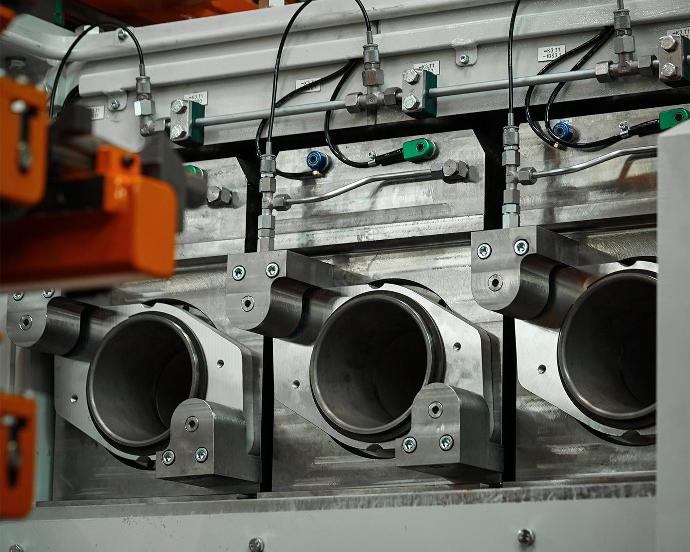
Figure 1: Drawing die of a tube drawing line with QASS structure-borne sound sensors mounted.
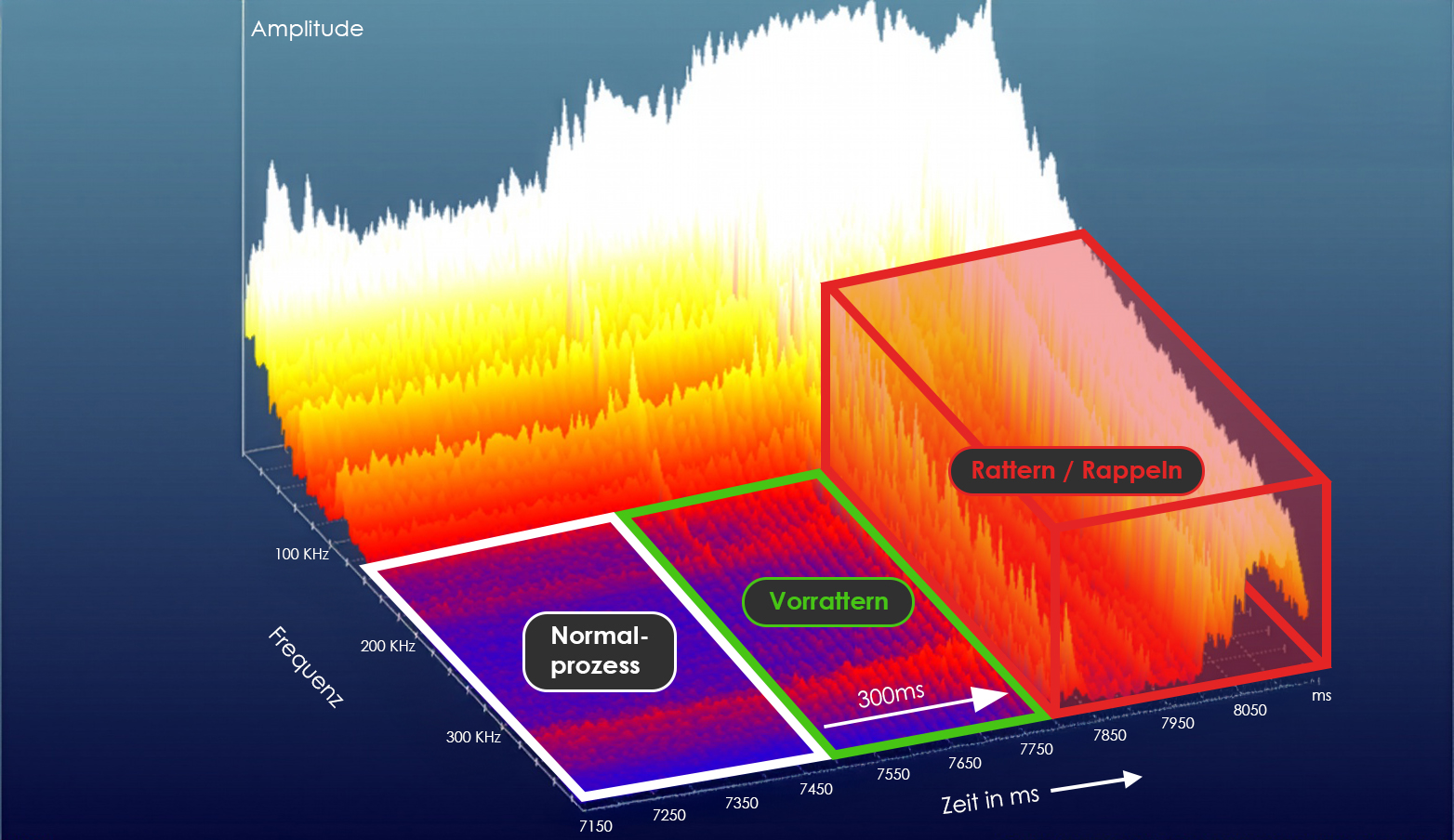 Figure 2: Visualization of a tube drawing process in the QASS spectral landscape (based on real-time FFT). Shown are parts of the "normal process" (white rectangle, no chatter), the preceding chatter precursor signals with a duration of approximately 300 ms (green rectangle), as well as the chatter itself (red area), the audible portion of chatter where damage occurs.
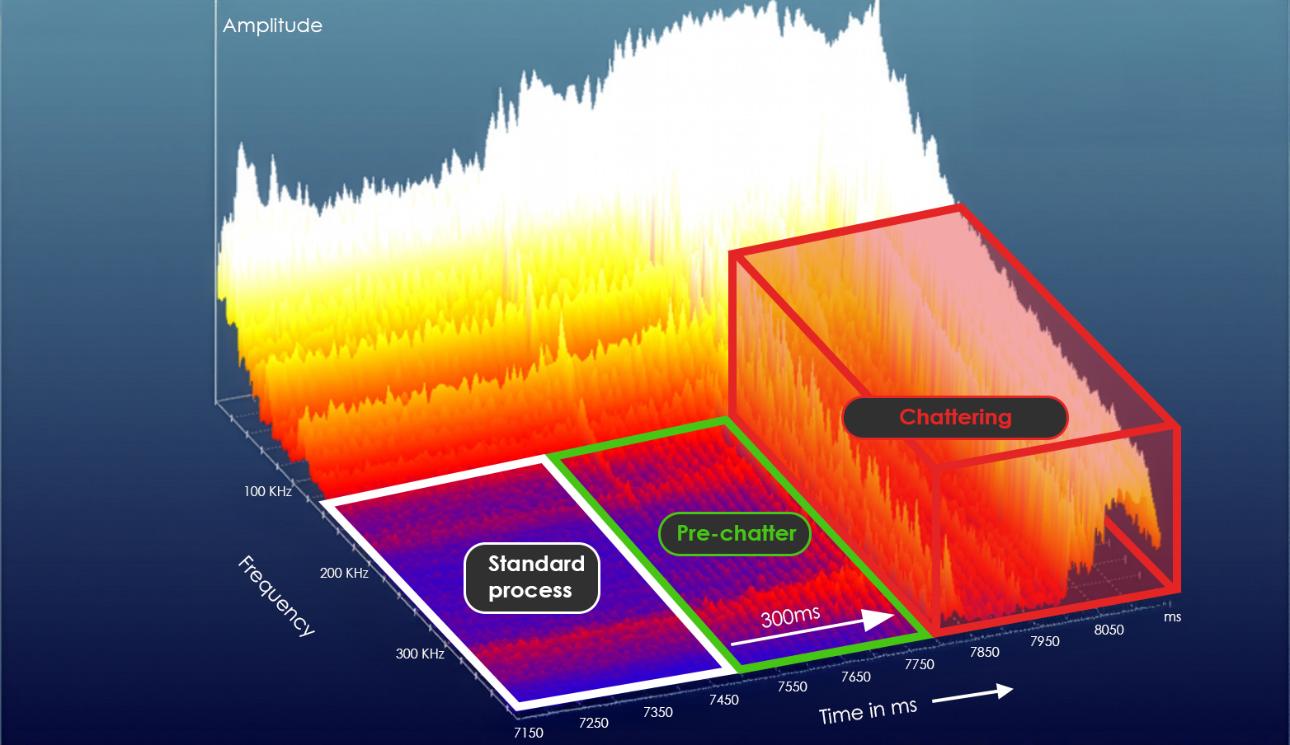 Figure 2: Visualization of a tube drawing process in the QASS spectral landscape (based on real-time FFT). Shown are parts of the "normal process" (white rectangle, no chatter), the preceding chatter precursor signals with a duration of approximately 300 ms (green rectangle), as well as the chatter itself (red area), the audible portion of chatter where damage occurs.
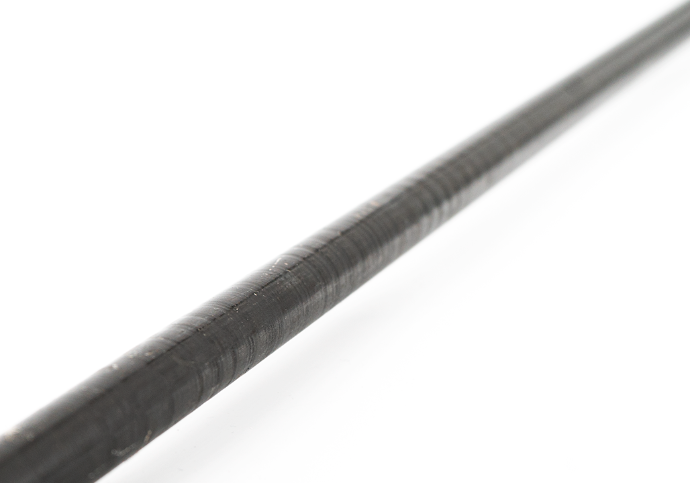 Figure 3: Visible chatter marks on the outer surface of a tube.
Adaptive increase in drawing speed without loss of quality
By reliably preventing chatter marks, QASS can now also gradually increase the drawing speed of the tube drawing line without reducing tube quality.
Tube drawing lines are typically operated at drawing speeds chosen so that chatter marks ideally do not occur or occur only rarely. Accordingly, these speeds are usually set conservatively, since the rule is: the higher the drawing speed, the more likely chatter marks occur.
By using our measurement technology, significantly higher drawing speeds can now be achieved without compromising tube quality. If the process runs stably over a certain period, we gradually increase the speed up to the optimum for the respective material and tube type.
In addition, QASS has developed a parameterization system that distinguishes between sensitive and less sensitive tube types, as well as between pre-drawing and finish-drawing processes.
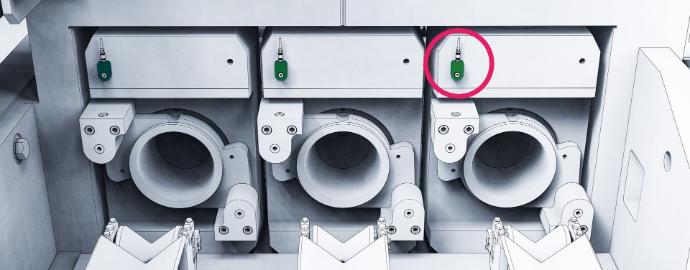 Figure 4: QASS sensors mounted on the drawing die of a Bültmann tube drawing machine.
Easy installation and operation
QASS measurement technology can be integrated into both existing and new tube drawing lines. The structure-born sound sensors are simply mounted on the drawing die of the tube drawing machine and continuously record all forming and friction forces acting between the inner and outer tools as well as the drawn tube. The signals are then transmitted to the Optimizer4D measurement system, which can be positioned as required.
Via analog interaces or common fieldbus protocols, the measurement system is seamlessly connected to the machine control. Even older machines without digitalized control systems can be directly controlled using specially developed additional hardware from us.
The device's graphical user interfaces can be individually customized to meet customer requirements, taking into account the on-site production conditions.
Successful reference projects in tube drawing
Since 2020, renowned companies have relied on QASS measurement technology. Following successful pilot projects, tube manufacturers such as voestalpine, BENTELER Steel/Tube, and Borusan have equipped additional lines with QASS technology. Users report productivity increases of between 10 and 20 percent (sometimes even higher) achieved through the adaptive increase in drawing speed. Leading machine manufacturers such as ASMAG and Bültmann also rely on QASS as a partner for modern measurement technology in tube drawing.




All advantages at a glance
How QASS measurement technology improves tube drawin.
Avoid chatter marks
By detecting chatter at an early stage and subsequently adjusting the speed, chatter marks are mostly avoided.
Improved surface quality
Production of tubes with optimal surface quality.
CO₂ reduction through reduced scrap
Less scrap due to the avoidance of chatter marks and other defects.
Simultaneous increase of production speed
Achievement of higher drawing speeds through adaptive speed control while maintaining consistently high tube quality.
Visualization of the actual speed in the statistics
Digitalization of old machines and visualization of real production data.
Reduced workload for employees through automation of the process
More time for operators to focus on other tasks.
The QASS project workflow
Request
You contact us, by phone or by mail, and describe your situation
Target definition
We define the goals of the project together with you.
Data analysis
QASS measurement equipment is installed and collects data that is subsequently analyzed.
Application
The measurement technology is specially adapted to your purposes.
Evaluation
Our system is tested and optimized at your site under production conditions.
Arrange a consultation appointment now!
Ask our experts about the possibilities for your industrial processes without obligation.
Measurement method structure-borne sound
By means of structure-borne sound analysis, important signals can be detected before damage occurs. The machine speed can be reduced in a timely manner to prevent damage.